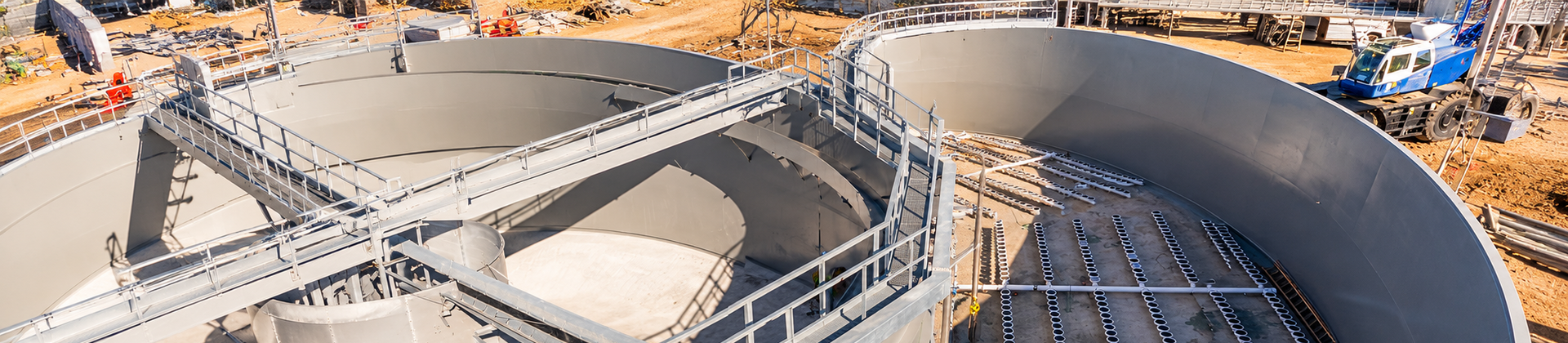
Identifying capacity limitations and diagnosing performance problems can guide your decision to rehabilitate your clarifier, replace it, or add capacity
In wastewater treatment, clarifiers play a key role in separating activated sludge from wastewater before the effluent passes to the next stage of treatment or is discharged. Secondary clarifiers need enough capacity to let solids settle and be removed while the clarified water moves on.
As inflow and biomass loads increase, a clarifier may not have the capacity to effectively separate the solids, particularly during periods of peak flow, when it is subjected to greater hydraulic loading. The clarifier system must separate these solids from the wastewater so they can either be removed from the system or returned to the aeration tank as return activated sludge.
Even when a wastewater treatment system has adequate biological treatment capacity, it may still struggle to handle additional throughput if its secondary clarifier cannot maintain effective solids separation. Pushing flows beyond what the clarifier can reliably handle can compromise treatment performance and effluent quality.
Signs Clarification Performance Is Becoming a Problem
When clarification performance begins to deteriorate, operators may notice warning signs such as:
- Deteriorating effluent quality: When the amount of solids entering the clarifier exceeds the gravity-settling and removal capacity, suspended solids escape with the effluent as it flows from the tank, compromising effluent quality.
- Solids carryover: When the system is subjected to hydraulic overloading, water can flow through too quickly, sweeping suspended solids with it as it exits the top of the tank.
- Rising sludge blanket: If return activated sludge pumping or sludge removal is inadequate, a thick layer of sludge can build up, reducing the volume available for active settling and contributing to solids carryover.
- Poor settling performance: Sludge may settle more slowly or inconsistently, reducing the clarifier’s effective operating margin.
- Inability to handle increased flows: Operators may notice problems during peak flows and a reduced operating margin as flows or solids loading increase.
While these symptoms highlight clarifier limitations, they do not automatically point to an undersized clarifier. Poor settling can also stem from inefficiencies elsewhere in the treatment process, and adding clarification capacity would not necessarily address the root cause.
What Actually Determines Clarifier Capacity?
Tank diameter is not the only factor that determines the capacity of a clarifier. Other factors to consider include:
- Hydraulic loading: While a clarifier may perform effectively during periods of average flow, it may have a much lower operating margin as the volume of wastewater passing through the clarifier increases.
- Solids loading: The clarifier must be able to separate biological solids that enter with the wastewater from the aeration tank, while also maintaining optimal sludge levels and return activated sludge flows.
- Settling characteristics: The ability of the solids to settle out is another factor to consider. When sludge doesn’t settle readily, it can negatively impact clarification performance even when there is sufficient space for the sludge to settle.
- Equipment efficiency: Factors such as clarifier geometry and depth, equipment condition, overflow weir configuration, and sludge removal arrangements can also affect clarifier performance. Equipment limitations or deterioration can reduce process efficiency and the clarifier’s effective capacity.
- Internal fluid dynamics: Uneven influent distribution can cause hydraulic short-circuiting, lowering the effective retention time and reducing clarification performance. Instead of moving slowly and evenly to facilitate settling by gravity, the water forms high-velocity channels that compromise settling performance and promote solids carryover.
- Effluent requirements: Stricter effluent limits require higher clarification performance and a larger operating margin.
Is the Real Problem Capacity or Performance?
Before adding infrastructure to expand clarification capacity, operators and engineers should carefully evaluate the system to determine whether the problem stems from inadequate clarification capacity or from operational, mechanical, or upstream conditions that can be adjusted.
A capacity evaluation may consider:
- Current and projected flows
- Peak hydraulic loading
- Solids loading
- Settling characteristics
- Sludge blanket behavior
- Return activated sludge rates
- Effluent quality
The assessment should also examine upstream and mechanical conditions that can affect clarification performance without necessarily indicating a fundamental shortage of settling area. These include:
- Hydraulic short-circuiting
- Uneven influent distribution
- Inadequate sludge removal
- Equipment deterioration
- Changes in biological treatment
Identifying the actual constraint can help operators and engineers determine whether targeted rehabilitation will suffice or whether additional clarification capacity is needed to improve performance.
Rehab, Replace, or Add Clarification?
If a clarifier has sufficient capacity but treatment performance has deteriorated, rehabilitation or equipment upgrades may offer an appropriate solution. Improvements to drives, pumps, influent distribution, sludge removal, or other components may improve performance without the need for additional clarification infrastructure.
Replacement may make more sense when an existing clarifier or its key components are approaching the end of their useful life, have structural or mechanical limitations, or when rehabilitation is not economically feasible.
In cases where increasing plant flows subject clarifiers to hydraulic and solids loading beyond what they can reliably handle, it may be time to consider expanding clarification capacity. This can involve adding another clarifier, replacing a smaller clarifier with a larger one, or expanding the clarification process as part of a broader plant upgrade.
AUC Group offers bridge- and pier-supported clarifier systems, including large-scale clarifiers exceeding 57 feet in diameter.
Plan Clarification Around Plant Growth
When a clarification problem surfaces, it’s time to understand why. Evaluating future flows and treatment requirements can help prevent solving one capacity constraint only to create another elsewhere in the treatment process.
For facilities facing increased inflows, clarification should be evaluated along with projected hydraulic and solids loading, treatment requirements, and future expansion needs.
AUC Group can help evaluate clarification needs and identify practical options to improve or expand wastewater treatment capacity. Contact our team to discuss your existing clarifier, projected flows, and options for improving your treatment system.